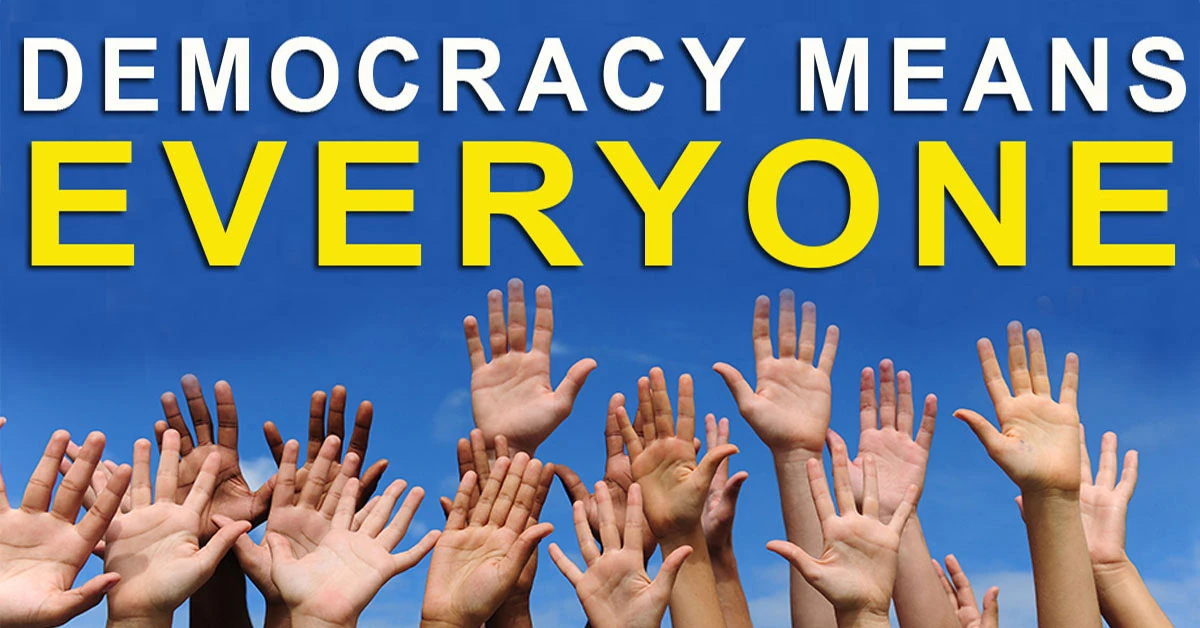
Some Misconceptions
As far as most historians are
concerned, democracy, meaning rule of the people or people-power first appeared
in Athens, Greece around 508 BC.
Apparently, Athenian men decided that only adult male citizens who owned
land should be the ones to make the decisions for all of society. Thus, in
terms of people being able to participate directly in the decision-making
processes of society, this limited form of democracy was a step in the
direction of a pure or real democracy. However, because it only permitted eligible
adult male citizens to participate, it was not actually a real democracy of
“all” the people of Athens, but a democracy of only eligible adult male
citizens of Athens.
Fast forward from
the days of ancient Greece to modern-day democracies and you will find around
the world that people, for the most part have even less opportunity to
participate in their democratic-systems than they did in those days. See, for a
democracy of the people, by the people and for the people to be REAL (as
opposed to just an idea or a belief in their democracies as is mostly the case
these days), requires that all of the people of the democracy really have the
opportunity to participate equally in all of the decision making processes of
that society. Thus, when it came to the democracy of Athens, Greece, it wasn’t
actually a democracy of “all” the people, but only of adult male citizens who
not only had to own land, but also had to have had the opportunity, time and
money to actually participate equally in all of the decision-making process of
that democracy. So, let’s consider for a moment what “the opportunity to
equally participate in the decision-making processes” would actually entail.
Because this is the point in which we will be able to honestly assess the
degree or quality of democracy that really exist within our societies.
I’ll say it again:
for a democracy “of the people” to be real, requires that all of the people of
that democracy actually have the opportunity to participate equally in all of
the decision-making processes. Let’s think about that for a moment. In your
respective democracies of your nations and societies, how much opportunity do
all of the people actually have to participate in the decision-making
processes? See, this is where we begin exiting the realm of fantasy,
brainwashed and indoctrinated beliefs of democracy and enter into the reality
that, our democracies, especially at the national level have never ever been
democracies of the people, by the people and for the people. It’s all been an
illusion.
Instead, what our
democracies have really been, going all the way back to the times of ancient
Greece, is nothing more than small groups of the wealthiest individuals making
the most important decisions in order to maintain their power and control of the
people mainly by way of their control of the money system, which in turn has
enabled them to control the military system, judicial system and so on all the
way down to the education-system which has been designed specifically to keep
the people dumbed down, indoctrinated and brainwashed into believing that we
were the ones in control.
Ever wonder why
students are forced to spend so much time studying to memorize huge amounts of
information that is useless for anything beyond filling in multiple-choice standardized
tests? It’s because, the last thing that most of the people in power and
control want, is for you to have any free time whatsoever to actually begin
questioning and investigating the purpose of the systems that manage and
control the people. Fortunately, with rapidly evolving technology and a new
understanding of democracy, we the people now have an opportunity to change the
situation by redesigning our so-called democracies to new systems wherein all
of the people will have the opportunity to participate equally in all of the
decisions-making processes of society.
Imagine how life on
planet earth might change if we all had access to the best technology and could
all decide where and how much each wanted to participate in the decision-making
processes of our societies. What would you be interested in focusing on and
where would you most care to participate?
In which form of democracy would you most care to
participate?
Imagine that you lived in a
community of 100-people enclosed in an environment (like earth, but much
smaller) with the most modern information communications technologies and
enough resources to sustain all of you forever as long as you all cooperated to
manage all of the resources wisely. How would you choose to participate in such
a community; or more specifically, how would you as one of the 100 care to
relate to the other 99 and how would you care to have them relate to you? Would
you choose (A) to participate in a Hierarchical-based system wherein one or a
few live like kings and queens in control of most of the resources, making all
of the most important decisions and all
of the most important rules while the rest of the community spend their lives
competing against one another just to survive? Alternatively, would you choose
(B) an equality based system, wherein each member of the community is afforded
an opportunity to participate equally in
all of the decision making processes – within as many or as few as each one
cared to participate? Take some time to think about this question and perhaps
discuss it with your friends and classmates. Then, make your decision as though
your future and future of humanity depends on what you decide.
If you chose (A) a
Hierarchical-based system wherein a few live like kings and queens in control
of most of the resources, making all of the
most important decisions and all of the most important rules while the
rest of the community spend their lives competing against one another just to
survive, congratulations you’re in luck.
Because, on a much larger scale, you are just where you care to be in
terms of modern-day democracy in the community of humanity in an environment
called the biosphere on a planet called Earth. However, if you chose (B) an
equality based system wherein each member of the community is afforded the
opportunity to participate equally in all of the decision making processes
(within as many or as few as each one cares to participate), unfortunately, you
are not so lucky, but that does not mean you have to accept the status quo. For
example, even though so many people have been indoctrinated and brainwashed
into believing that food and water are commodities that must be bought and paid
for by money earned in the servitude of others, the fact is that such resources
(except for the human labor involved) are provided freely by earth.
Who was it that
decided that a small minority of people should rule over the vast majority? Who
was it that decided those same people could control most of earth’s resources
while charging the masses for the water, fruits and vegetables that earth
provides for free? I don’t recall voting on any issue that asked us if we
wanted to give fifty percent of the world’s wealth to just one percent of the
population, do you? Of course not, because our so-called democracies only allow
the ninety-nine percent to vote every two to four years and even then, our
choices are extremely limited to say the least.
Think about it! Even if a truly honest, good person gets elected to the
presidency, it will have cost a huge amount of money. Where do you think most
of that money comes from? It certainly doesn’t come from the poorest people,
the ones with the most need.
Unit 3: Representative democracy vs real democracy
The problem with today’s
democracies is that, they do not provide all of the people with an opportunity
to participate equally in the decision-making processes of society. Take for example representative democracy,
wherein an extremely small minority of the population, usually from the wealthy
class, make the rules and the laws for all of society. They decide which
history books we study in school, how long we have to stay in school, when to
fight in wars, who is allowed to travel and even which chemicals are allowed in
our food. Perhaps, in the days of horse travel and printed news, this form of
democracy made sense because people did not have the technology to access
information and it was not possible to include all of the people's voices in
all of the decision-making processes. Nowadays, however, we do have the
technology, which gives us the ability to provide all of the people with the
opportunity to participate equally in as many or as few of the decision-making
processes as they are able.
Imagine how
different things would be if we human beings took back our power from the elite
and began making our own decisions. Think about where you personally might get
involved in changing things. Would you still allow 1% of the global population
to have and control 50% of the global wealth, the land and the resources? I
wouldn’t allow it and I don’t think that the majority of humanity would either.
Yet, this is how it currently is based on the current design of our democratic
systems. Not to worry though, because a mass awakening is occurring and with
this awakening comes opportunity to stand up and become the change that you
would care to see everywhere.
Real democracy is
simply a form of collective/group decision making, wherein the degree of
democracy expressed is equivalent to the degree by which "all"
members of the collective have the opportunity to participate equally in all of
the decision-making processes that affect the collective. For example, let’s
say there are 10 members in a collective wherein 100 relevant decisions are
made each year. If all 10 members of the collective have the
"opportunity" to participate equally in all of the one-hundred
decision-making processes, then we would say that their democracy is a pure or
real democracy. Why? Because it is functioning at 100% of its potential.
In other words,
regardless of how big the community is, as long as all of its members have the
opportunity to participate equally in all of the decision-making processes,
then that is considered a real democracy because one-hundred percent of the
people have the “opportunity to participate in one-hundred percent of the
decision-making processes. It’s like “truth”; anything less than 100% is not
actually the truth, but a fraction of a lie.
Thus, it is that
real democracy is also a collective expression of real equality, wherein all
members of the collective have the “opportunity” to participate equally in any
and all of the decision-making processes that affect the collective.
Consequently, if 99% of the members of a collective are only permitted to
participate in one or two of the decision-making processes every 2-4 years, as
is the case with most representative democracies around the world, then it
would be incorrect to say that those democracies are real or true, simply
because the decision-making opportunities do not apply equally to all members
of the collective. Remember, for something to be true or real, it must apply
equally to all.
Unit 4: What is the biggest influence on people’s opportunity to
participate?
In this unit, we are going to
explore the factor that most influences people’s opportunity to actually
participate in the decision-making processes of society. For, once we
understand what the biggest limiting factor is to our current forms of
democracy, we are then able to focus our attention on changing or correcting it
for the purpose of improving the functioning of our democracies. So, what do
you think is the biggest factor of day-to-day living that mostly influences or
limits the amount of opportunity that people have to participate in their
democratic systems?
If you guessed
money to be the biggest factor or aspect of day-to-day living that influences
the extent of people’s opportunity to participate in their democratic systems,
then you guessed correctly. Why money? Because, like it or not, the money-system
dominates (and therefore defines) all other systems such as the education
system, the legal system, transportation system, military system, government
system and so on within and throughout most of humanity. Consequently, even
though many may believe that our democratic systems of government are designed
to be fair and give everyone an equal opportunity, the reality is that, no
system of government (as of yet) has ever managed to supersede or override the
power and control of money. Therefore, as a result of the way the current world
system is setup, the more money one has, the more opportunity or power he or
she will have to participate in the democratic (decision making) processes of
society. Remember the saying, money is power?
Actually, money is just the representative of power within the world
system of humanity.
Remember
the example of a real democracy wherein one-hundred percent of the people had
the opportunity to participate equally in one hundred percent of all of the
decision-making processes? Imagine how it would be if each person’s opportunity
to participate in the decision-making processes were based on how much money or
wealth each one had. For example, imagine that one dollar or one yuan equals
one vote and the more money each person had, the more votes he or she could
cast. Obviously, the people with the
most money would end up making most of the rules to administer and control most
of society. And even though we might call it a democracy, it still wouldn’t be
a real democracy of the people, by the people and for the people. Rather, it
would actually be a democracy of the money, by the money and for the money,
representing (for the most part) the people with the most money.
Remember, just
because we decide to call our governments, representative democracies, doesn’t
mean that such democracies are actually setup to represent all of the people
equally. Sure, today’s democracies are indeed for the most part, representative
democracies. Unfortunately, the degree by which people are actually represented
by their democracies is based not on the value of life, but the value of money.
And this my fellow human beings is the underlying cause of the devolution of
humankind.
The distribution of wealth as it correlates to the functioning of our
democracies
Although it is not feasible to
quantify every-single factor that determines and/or limits how much opportunity
a person has to participate in the decision making processes of society, it is
quite easy to calculate the extent of a person’s ability to participate in
terms of how much he or she can afford to participate. For example, imagine
there are two identical twins of the same physical strength and the same IQ who
both want to participate in the democracy of their nation. One of them has
millions of dollars to play with, while the other one has to work ten hours a
day, six days a week just to pay the bills to support the family.
Which one do you
think is going to have more opportunity to participate in deciding the
direction of the nation? As the wealth of an individual is clearly the greatest
factor that determines and/or limits one’s opportunity to participate in any
aspect of human society, we can therefore, use the distribution of wealth (within a nation) to grade that
nation’s democracy. Basically, the more equally a nation’s wealth is
distributed, the better its democracy will function, because people’s opportunities, based on how much
time and money they can afford to spend on that participation will be more
equally distributed. Thus, a possible solution to low functioning democracies
would be to redistribute the wealth more equally within that democracy.
Have a look! In
modern-day democracies, less than 1% of the people have the opportunity to
participate in all of the actual decision-making processes of society. This
means that, if we were to assign a grade (for example) to the representative
democracy of the United States, we would give it a failing grade of less than
1%. Why? Because, that is the percentage of people that actually have the
opportunity to participate in all of the decision-making processes. Thus, if we
look past the brainwashing of our education systems and the propaganda of our
corporate owned media, we see that, modern-day democracies are not even close
to being democracies of the people, by the people and for the people. Why?
Because only a tiny fraction of the people have the opportunity to participate
equally in all of the decision making processes.
Furthermore, as the
inequality between those who have the most opportunity to participate and those
who have the least opportunity to participate is directly related to the
distribution of wealth, the most obvious key to increasing participation in our
democracies is to decrease wealth-inequality within our societies. Does this
mean that the wealth of nations should be redistributed more equally to all of
the people? Perhaps, but this would require designing and implementing a new
economic system, such as the Living Income Guaranteed model proposed by the Equal
Life Foundation.
Solutions for low functioning democracies
The problems of humanity are not going to be solved by
themselves. If we, the ninety-nine percent really want to improve the quality
of our democracies, we are going to have to work together, peacefully from the
ground up to build a new system based on the principles of equality in
consideration of what is best for everybody.
This requires that people begin
taking on more responsibility by investigating the problems, communicating with
one another, designing solutions and then deciding among ourselves which
solutions we are going to implement. Specifically, don’t expect the one percent
of the population that is in control of our governments, to redesign our
systems of government. This does not mean that many good intentioned people at
the top of the system do not want to change the system, but that they by
themselves are simply unable to do so by themselves.
The bottom line is that, in order
for us to correct or improve the functioning of our democracies, we’re going to
have to improve the distribution of wealth, i.e., find ways to provide
everybody with enough money and resources so as to equalize the opportunities
that people have to participate in the decision-making processes of society.
Doing this requires that, we upgrade from representative democracy to a more
direct form of democracy, wherein people would be able to use the most modern
technology to ensure that everyone at least have the opportunity to participate
or vote in whatever areas they choose to participate.
The fact of the matter is, we as a
human race have already entered into the final stretch of the human race and
what we do now and do not do right-now will have a tremendous impact on the
quality of life for generations to come. Perhaps it’s time to redesign our
world systems by eliminating the rules that promote inequality and replacing
them with the principles of equality, oneness and what is best for all. After
all, even after all is said and done, we are still one. Thus it is my intention
and my hope that, from this new understanding of democracy, you will begin to
take it upon yourselves to push for change by becoming that change. Always
remember that real change starts from within.
Again: the
collective expression of real democracy is simply the collective expression of
real equality of opportunity to participate in the decision making processes of
the collective. Of course, it is not a state that humanity is going to attain
instantly. Rather, it is a process wherein every move we make to change
ourselves in the direction of real democracy is a step in human evolution.
Anything less is unfortunately devolution.


